
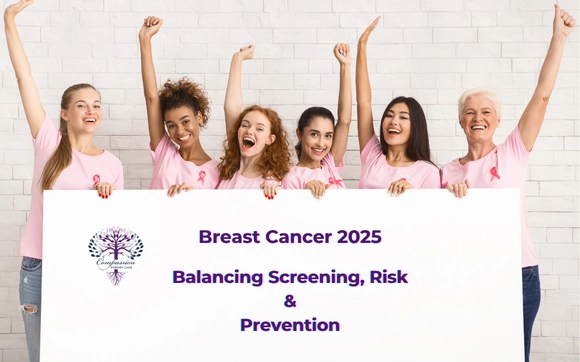
Understanding the Scope
In 2025, about 316,950 women in the United States will receive a diagnosis of invasive breast cancer.¹ While death rates have declined in recent decades, the financial burden now exceeds $30 billion each year. The personal cost remains high. Many women face emotional strain, long treatment plans, and lasting side effects.²
The Mammogram Debate: What the Numbers Really Mean
Assumptions Behind Screening
Traditional mammography programs were built on two now-challenged ideas:
1. Breast cancers grow linearly and predictably, so earlier always equals better detection.
2. All detected cancers progress, justifying universal intervention. Yet research shows tumor behavior is heterogeneous; some grow rapidly, others never threaten life, and some regress spontaneously. ³
Radiation & False Positives
One digital mammogram exposes a woman to about 0.4–0.5 mSv of radiation. This equals roughly eight weeks of natural background exposure.⁴ The dose is small, but yearly screening over decades increases cumulative exposure. This is especially relevant for younger women.
False positives are common. Over ten years of annual screening, 50–60% of women will receive at least one false alarm. These results often lead to more imaging, biopsies, and significant anxiety.⁵
Absolute vs Relative Risk Reduction
Mammography benefits are often presented as relative risk reduction:
-
Relative reduction in mortality: 15–25%⁶
Absolute numbers tell a clearer story:
-
Absolute risk reduction: about 1–2 deaths prevented per 1,000 women screened over 10–15 years (around 0.1–0.2%)⁷
-
Number needed to screen: about 500–1,000 women for ten years to prevent one death⁷
Mammography can save lives. However, the overall benefit is modest. It must be weighed against overdiagnosis, radiation exposure, and emotional impact.
Alternative & Adjunctive Screening Options
QT Scan (Quantitative Transmission Ultrasound)
QT scan uses three-dimensional ultrasound tomography to image breast tissue without compression or ionizing radiation. Early studies suggest:
-
Detection rates similar to mammography in dense breasts⁸
-
Improved comfort for patients⁹
-
No long-term mortality data yet
QT scan is FDA-cleared as an adjunct, not a replacement, and is still being evaluated in multi-center trials.
Auria Tears (Tear-Based Biomarkers)
The Auria test analyzes tear proteins associated with inflammatory or metabolic shifts linked to breast tissue changes.¹⁰ Preliminary data show promise but also high false-positive rates; large validation trials are ongoing. For now, tear-based tests are best viewed as non-invasive adjuncts, not substitutes for imaging.
Iodine and Breast Health: Revisiting the Evidence
The Auria test analyzes tear proteins linked to inflammatory and metabolic changes associated with breast tissue activity.¹⁰ Early research is promising, but false-positive rates remain high. Larger validation studies are ongoing. At this time, tear-based testing should be viewed as a non-invasive adjunct rather than a substitute for imaging.
- Epidemiologic observations link low iodine intake to higher breast cancer rates.¹³
- Human trials remain limited; small studies report symptom improvement in fibrocystic breast disease with molecular iodine supplementation.¹²
- Mainstream oncology views these findings as hypothesis-generating, pending randomized trials to define safety, dosage, and long-term outcomes.
- However, in clinical practice, both these doctors and many other clinicians utilize iodine treatment successfully in women with fibrocystic breast, breast cancer, and a plethora of other conditions.
In clinical practice, iodine optimization should consider thyroid function, halide exposure (bromide, fluoride, chloride), and be guided by a qualified practitioner.
Beyond Screening: Integrative Prevention Strategies
Hormone Optimization
Healthy estrogen-to-progesterone balance reduces excessive cell growth in breast tissue. Supporting detoxification pathways such as methylation, sulfation, and glucuronidation is essential. Reducing exposure to environmental estrogens, including BPA, phthalates, and parabens, also supports hormonal balance.¹⁴
Cortisol & Stress Regulation
Chronic stress raises cortisol levels, which can suppress immune function, increase inflammation, and disrupt hormone balance. Practices such as mindfulness, breathwork, adaptogenic herbs, and regular physical activity help restore healthy HPA-axis function.¹⁵
Metabolic & Weight Management
Visceral fat increases aromatase activity and inflammatory signaling, raising breast-cancer risk after menopause. Regular exercise, resistance training, and insulin-sensitizing nutrition patterns significantly reduce this risk.¹⁶
Nutrition & Lifestyle
- High intake of cruciferous vegetables, fiber, and omega-3 fats
- Adequate vitamin D, magnesium, selenium, and zinc
- Time-restricted eating to improve insulin sensitivity
- Strict alcohol limitation, as even low intake increases risk¹⁷
- Consistent 7–9 hours of quality sleep to support melatonin and circadian rhythm regulation¹⁸
Reframing the Conversation
Screening saves some lives, but not all, and it comes with real costs. The future of breast-cancer prevention lies in a personalized approach. This includes thoughtful imaging choices, metabolic health, stress resilience, and nutritional sufficiency, rather than reliance on any single screening tool.
References
- American Cancer Society 2025 Estimates.
- National Cancer Institute, Cancer Care Costs 2020 Report.
- Bleyer A, Welch HG. N Engl J Med. 2012;367:1998–2005.
- U.S. FDA, Mammography Quality Standards Act.
- Nelson HD et al. JAMA Intern Med. 2016;176(12):1751-1760.
- Independent UK Panel on Breast Cancer Screening. Lancet. 2012;380:1778-1786.
- Gøtzsche PC, Jørgensen KJ. Cochrane Database Syst Rev. 2013;(6):CD001877.
- Duric N et al. Med Phys. 2014;41(2):023502.
- Skaane P et al. Radiology. 2020;296(2):284-291.
- Bhardwaj S et al. Front Physiol. 2022;13:861321.
- Brownstein D. Iodine: Why You Need It, Why You Can’t Live Without It. Medical Alternatives Press; 2023.
- Kessler JH. Breast J. 2004;10(5):404-406.
- Eskin BA et al. Breast Cancer Res. 2005;7(4):R506-R514.
- Kaaks R et al. Endocr Relat Cancer. 2022;29(2):R29-R50.
- Sephton SE et al. Psychoneuroendocrinology. 2016;69:1-10.
- Chlebowski RT et al. J Clin Oncol. 2020;38(20):2142-2152.
- Bagnardi V et al. Ann Oncol. 2015;26(8):1630-1638.
- Hansen J et al. Epidemiology. 2011;22(5):799-806.
Author: Dr. Stasha-Gae Roberts
Doctor of Nursing Practice
DNP, MPH, MSN, APRN, AGPCNP-BC
Nursing your journey to lasting wellness.
